


PAN Card Eligibility
PAN Card eligibility covers every Indian taxpayer, business, and NRI, as well as foreign citizens and entities operating in India, each with its own document requirements. Quoting a PAN is mandatory for several government-specified transactions, and a taxpayer, guardian, or authorised representative can also apply for a PAN on behalf of another person, including a minor.
PAN Card Eligibility Criteria and Documents Required for Indian Citizens
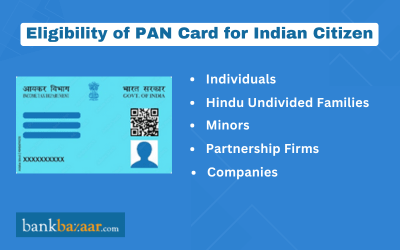
There are different eligibility criteria and documents required for Indian citizens who wish to own a PAN, depending on whether the PAN is required by an individual, firm, enterprise, association, etc. The basic criteria are mentioned below.
- Individuals - The applicant should be a citizen of India with a valid address, date of birth and ID proof. This proof can be either a passport, driving license, Aadhar, Voter Id card, etc.
- Hindu Undivided Families - The Karta (head) of a Hindu Undivided Family can apply for a PAN on behalf of the family by providing a valid ID, address proof and date of birth for all members of the family. The Karta is also expected to mention the father's name in order to apply for a PAN.
- Minors - A parent/guardian can apply for a PAN on behalf of a minor by providing a valid address proof and ID of the parent/guardian.
- Indian citizens residing abroad - If the applicant is an Indian citizen who resides outside the country, he/she should provide a copy of his/her bank account statement in the present country of residence as address proof.
- Mentally challenged individuals - There are cases where a mentally challenged individual might require a PAN and in this case a representative can apply on his/her behalf. The representative will have to provide details of such an applicant (ID proof, address proof and date of birth) plus his/her (representative's) details.
- Companies - Companies which need a PAN should be registered with the Registrar of Companies and should provide a copy of their registration certificate.
- Partnership Firms/Limited Liability Partnerships - These entities should be registered with the relevant government authorities and should submit a copy of their registration certificate.
- Trusts - Trusts which are registered can apply for a PAN by submitting a copy of their trust deed or registration certificate.
- Associations/Local authorities - Registered associations or local authorities can apply for a PAN by submitting a copy of their agreement or registration certificate.
- Artificial Juridical Person - Such entities can apply for a PAN by submitting proof of their identity and address, either in the form of government documents or registration certificates.
- Entities with no office in India - Firms, companies, trusts, artificial juridical authorities, etc. with no office in India need to apply by submitting their ID proof and address. This proof can be either in the form of their registration certificate from the country in which they are located, attested by the Indian Embassy/Consulate of that country. In case this is not available they need to get a registration certificate in India or approval documents from relevant authorities.
- Instant e-PAN via Aadhaar - An individual who does not already hold a PAN can get a free instant e-PAN by verifying a valid Aadhaar linked to an active mobile number and using DigiLocker on the Income Tax Department's e-filing portal; this route is not available to minors or existing PAN holders.
Note: Indian individuals apply for a PAN using Form 93, and Indian entities such as companies, firms, trusts, HUFs and associations use Form 94
PAN Card Eligibility Criteria and Documents Required for Foreign Citizens
Foreign citizens and organizations who are keen on setting up base in India need to satisfy a few basic eligibility criteria and submit the following documents in order to obtain a PAN.
- Foreign citizen (Individual) - Individual foreign citizens who wish to apply for a PAN can do so by providing relevant ID and address proofs. This can be either their passport, PIO card, citizenship ID number, etc.
- Companies - Foreign companies can apply for a PAN by furnishing a copy of their Registration Certificate from the country where an applicant is present. This should be attested by the Indian Embassy/Consulate/High Commission in that country. A copy of the registration certificate approved by Indian authorities in India will also suffice as proof for PAN.
- Firms/Associations/Trusts - Such entities can apply for a PAN if they are registered and have a registration certificate from the country where they are located. This registration certificate should be attested by the Indian Embassy or Consulate or High Commission in that country.
Note: Foreign individuals apply for a PAN using Form 95, and foreign entities use Form 96, with the eligibility criteria and documents required staying the same regardless of whether a foreign applicant is located inside India or outside while applying for a PAN.
PAN Card - When is it Mandatory?
Given below are some reasons to apply for a PAN Card
- In case jewellery is purchased above a certain limit, it is mandatory to provide the PAN Card.
- PAN Card must be provided for investments of Rs.50,000 and above.
- To sell the car.
- In case Rs.50,000 and more is deposited in the bank account.
- In case the restaurant bill is Rs.25,000 and more.
- In case you buy or sell an immovable that costs Rs.10 lakh and above.
- To open a bank account.
- PAN Card can be submitted as proof of identity.
- To file Income Tax Returns
- To apply for a credit or debit card.
- To open a demat account with a depository.
- In case a time deposit of Rs.50,000 or more is made, or total time deposits exceed Rs.5 lakh in a financial year, with a bank, post office, Nidhi or NBFC.
- In case a bank draft, pay order or banker's cheque worth Rs.50,000 or more is bought in cash on a single day.
- In case cash payment of Rs.50,000 or more is made for foreign travel or to buy foreign currency at one time.
- In case Rs.50,000 or more is paid in a financial year towards one or more prepaid payment instruments.
- In case Rs.50,000 or more is paid as life insurance premium in a financial year.
- In case securities other than shares worth Rs.1 lakh or more are bought or sold in a single transaction.
- In case unlisted shares worth Rs.1 lakh or more are bought or sold in a single transaction.
- In case goods or services, including jewellery and bullion, worth Rs.2 lakh or more are bought or sold in a single transaction, other than the categories listed above.
Who Does Not Need a PAN Card?
The below-mentioned entities need not apply for a PAN Card
- Individuals who have an income that is not taxable need not apply for a PAN Card. Form 60 can be submitted in case they wish to invest in mutual funds.
- Form 60 declaration - A person without a PAN can also submit Form 60 for any other transaction specified under Rule 114B of the Income-tax Rules, not only mutual fund investments, as provided in the CBDT's procedure for Form 60 submission.
- For certain transactions, NRIs need not provide the PAN Card.
- Minors are not required to have a PAN Card unless they are a nominee for property, or have taxable income or investments in their own name
Related Articles on PAN Cards
FAQs on PAN Card Eligibility
1.Who is eligible for a PAN Card in India?
Any Indian citizen, Hindu Undivided Family, company, firm, trust, or other entity engaging in specified financial transactions is eligible for a PAN Card, along with foreign citizens and entities operating in India. Eligibility depends on the applicant type, with different documents required for individuals, businesses, and minors. A parent, guardian, or authorised representative can also apply for PAN Card eligibility on behalf of someone else.
2.Which form is used to apply for PAN Card eligibility in India?
Indian individuals apply for PAN Card eligibility using Form 93, while Indian companies, firms, trusts and other entities use Form 94. Foreign individuals use Form 95 and foreign entities use Form 96, along with documents attested by the Indian Embassy, Consulate or High Commission where required. All four forms can be submitted through UTIITSL or Protean eGov.
3.Can an NRI apply for PAN Card eligibility in India?
Yes, a non-resident Indian meets PAN Card eligibility by submitting the prescribed individual application form, along with the required identity and address proof, to a PAN application centre of UTIITSL or Protean eGov. NRIs can provide a bank account statement from their country of residence as address proof. For certain specified transactions, however, an NRI need not provide a PAN Card.
4.Are minors eligible for a PAN Card?
Minors are generally not required to have a PAN Card, but PAN Card eligibility does extend to a minor who is a nominee for property or has taxable income or investments in their own name. A parent or guardian applies on the minor's behalf by providing their own valid ID, address proof and the minor's date of birth. The instant e-PAN facility, however, is not available for minors.
5.Can foreign citizens meet PAN Card eligibility requirements in India?
Yes, foreign individuals, companies, firms, associations and trusts can all meet PAN Card eligibility criteria by submitting valid identity and address proof, such as a passport or PIO card. Foreign companies and entities need a registration certificate from their home country, attested by the Indian Embassy, Consulate or High Commission. The documents and eligibility criteria stay the same whether the foreign applicant is inside or outside India at the time of applying.
6.Why is a PAN Card important?
A PAN Card is important because it is mandatory for filing income tax returns and for a range of specified financial transactions, such as opening a bank account or investing in securities. It also serves as an accepted proof of identity. Meeting PAN Card eligibility criteria early helps individuals and entities carry out these transactions without delay.
7.Who does not need a PAN Card?
Individuals whose income is not taxable generally do not need a PAN Card and can submit Form 60 instead for transactions that would otherwise require one. NRIs are also exempt from providing a PAN Card for certain specified transactions. Most minors fall outside PAN Card eligibility requirements unless they hold property or investments in their own name.
8. Is it possible to apply for a PAN Card online?
Yes, applicants who meet PAN Card eligibility criteria can apply online through the UTIITSL or Protean eGov websites by submitting the prescribed application form with the required documents. Individuals with a valid Aadhaar linked to an active mobile number can alternatively use the Income Tax Department's free instant e-PAN service. Both routes let applicants avoid an in-person visit to a PAN centre.

Disclaimer
Credit Card:
Credit Score:
Personal Loan:
Home Loan:
Fixed Deposit:


Copyright © 2026 BankBazaar.com.